|
||
 |
The Early Days |
 |
 |
||
| The Kagnew Home Page has had very
little input about the very early days of American involvement in Ethiopia and
Eritrea. Terry Hicks overheard some talk in a restaurant and in turn met Jim
Hatfield who was there in the early 40s! Jim is legally blind but has a
computer setup that allows him to surf the web and he's found the Kagnew page.
He has also agreed to pass along his stories of the very "early days" to you so
I hope you enjoy reading about something very few of us know much about.
(Since this was originally posted, Jim has passed on, but Terry would like
to keep his memory alive-Rick) Jim Hatfield If there is anyone else out there that would like to also add their stories to this area please use the link below and send them in. |
|||
| From Dave
Engstrom: The Earliest Days by Dave Engstrom (Adobe PDF) After I read a History of Kagnew Station shortly after Rick first posted it back in 2007, I was skeptical that U.S. forces didn't really arrive in Eritrea until April 1943. So I began to do some further reading, mostly over at the FSU library here in Tallahassee. I did that on and off almost five years, collecting information and building a chronology of notes that eventually grew to over 80 pages. But I wasn't getting anywhere. One day about two or three months ago I googled a text string from one of my sources and lo and behold I got several hits. It seems that in the interim much had been put online, including the entire series of "green books," The United States Army In World War II. And I discovered that google.news can now be searched as early as 1941. Just incredible. So that motivated me, and I finally pulled together what I had found into some semblance of a readable format. There certainly were some surprises. Notable was the fact that the first permanent U.S. military in Eritrea was not the forerunner of ASA (the SIS). On top of that, the earliest U.S. Army arrivals got to Eritrea more than a full year before 2d Lt Clay Littleton. Still, my reading left me with a number of questions. 1. Does anyone have any idea where the Asmara Arsenal was located? 2. Exactly who was the American Volunteer Guard/Eritrea Service Command? 3. Does anyone recognize the location of Eritrea Service Command HQ? 4. Does anyone know anything about Pan Am's operations in Asmara in 1942? 5. Anybody have a clue as to the date of the photo of the towers at Radio Marina? Guessing mid '40s? Dave Engstrom Co. B, '65-'68 (Unfortunately Dave passed away in 2017) |
|||
| My dad, Dick Turpin, from Ottumwa, Iowa,
worked for Douglas Aircraft on the base at Gura. He sailed on the Monterey out
of Charleston and the Rajula from Bombay. Dad wrote about his experiences for
my brother and I, and I just finished retyping them to send to my brother and
his son, along with a copy of Jeff Shaara's The Rising Tide. Googled Gura to
get a map to send too and found your web site. Here is part of what he wrote. (Word document) Daddy wrote this in 1994 when he was 79. He died in 2001. Best regards, Marianne Turpin Deterly Black Mountain, NC |
|||
| Books about Project 19, the very early
beginnings of our presence in Eritrea: Project 19: A Mission Most Secret John W. Swancara. (on amazon.com) World War II was two years old and America was still described as a "non-combatant and neutral nation." By the early fall of 1941, Britain was being pushed to the brink of disaster in North Africa. Time was running out and so were the combat ready planes of Britain and its allies. Churchill asked Roosevelt for "some help." Roosevelt responded by authorizing a secret mission. Build an Air Depot, to be operated by American Civilian volunteers under the direction of Douglas Aircraft Company. It would be classified "Secret" and given the title of "Project 19". Its location was 1,100 miles from the ever changing front lines in remote Eritrea, Ethiopia. This depot repaired hundreds of worn out and combat damaged "lend lease" P-40 fighters for the RAF. Then went on to repair many heavily used USAAF C-47 transports, assemble and deliver hundreds of new P-40s for the arriving USAAF Fighter Squadrons and rebuild dozens of combat damaged B-17s and B-24s. What did this secret project accomplish? What became of it? Read this Aviation Adventure story that took 6 years of research, personal interviews and sleuthing to assemble into 304 pages of history, combat accounts, with 150 plus photographs. A True Story! The Voyage by George Carlson (on amazon.com) This is the story by George Carlson about his journey and experience with Project 19. I signed up with Douglas Aircraft's Project 19 in 1941 – before Pearl Harbor. About 600 of us left the Hotel New Yorker, where we'd been put up, boarded trains that took us to Charleston where we were put aboard the Agwileon - a ship that didn't have room for us – and then aboard the USAT Monterey. We departed from Charleston, S.C. on Mar. 21, 1942 aboard the Monterey and arrived Massaua, Africa on June 12, 1942 aboard the HMS Rajula from Bombay. |
|||
| Information and picture of the main gate, Radio Marina from Stefano Pettini (Italy). | |||
Currently being hosted on
Terry Hick's Server (currently offline, checking into it)
|
|||
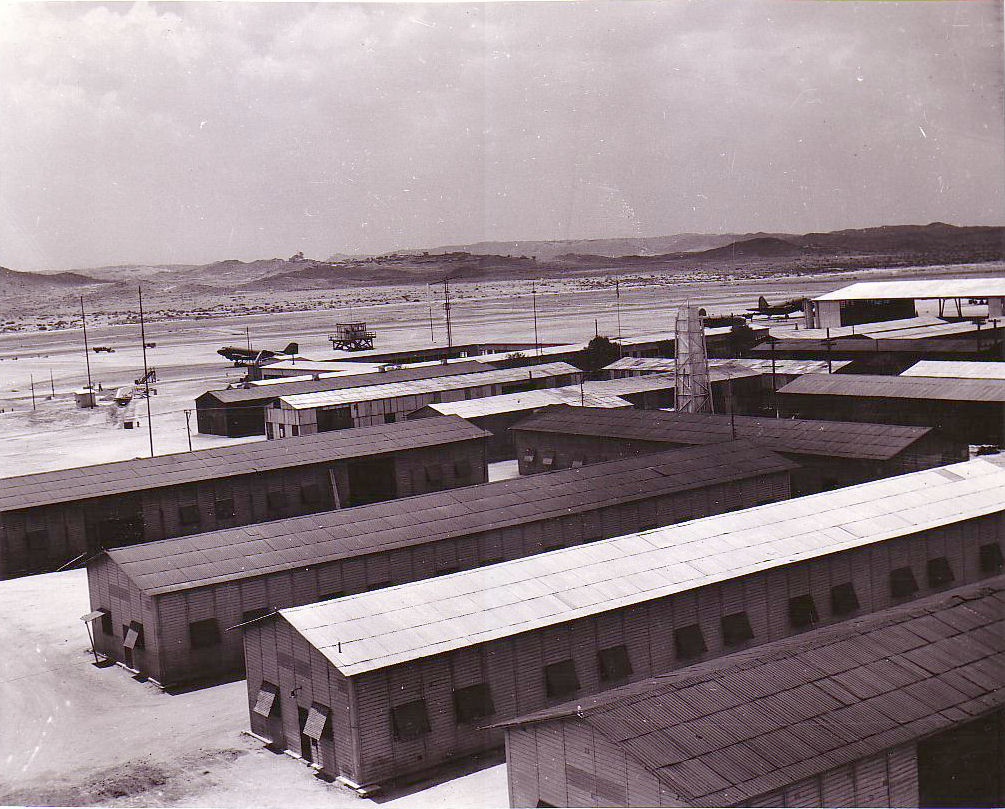
| Ed Musal sent in a picture he found on ebay of the Gura Army Air Base. | |||
| Early pictures from Chernet Haile. | |||
| Jerry Grover sent in this
excerpt from John Gunther's book, "Inside Africa" which was published in 1955.
I found it interesting. The Secret American Base in Eritrea Not one American in ten thousand knows it, but the United States maintains in Asmara a substantial hush-hush military base, knows as Radio Marina. This is not a base in the sense that it houses aircraft, like the bases in Morocco; it is highly specialized. Radio Marina has been in existence since 1942, and has some forty American officers and six hundred GI's; most are expert radio technicians. Its chief function is to be an all weather, all-year transmission point for United States government radio communications. The weather in Eritrea favors this; so does the altitude; so does the geographical location. During the Korean War radio traffic between Washington and Korea was of course incessant, but weather conditions over the Pacific often interfered with messages. Dispatched the other way around, via Asmara, they always got through. Then, although small, Radio Marina has other uses and advantages. Broadcasts anywhere in the Middle East are easily monitored from here. To have an American communications center on the Red Sea, comfortably established, and in expert working order might be a considerable convenience in the event of war-war in the Middle East or elsewhere. Finally. Radio Marina is a useful watchtower for American observers looking at Africa as a whole. I was interested in all this-also in the chocolate milk shakes at the PX Not for a long time had we tasted such indigenous American delicacies The Emperor, visiting Radio Marina not long ago, also found the milk shakes objects of satisfaction. Radio Marina is maintained with efficiency, precision, and courteous regard for the Eritreans. Eritreans and Ethiopians are delighted to have it here, because obviously it gives the United States a stake in their country. The Chief Executive of Eritrea drops in occasionally to have a manicure. And T-bone steaks cost 55 cents. Once again, as in North Africa, I felt intense admiration for the way Americans, so far from home, manage to make the best of a difficult post, remain cheerful, do an admirable job, and never (unlike Europeans) get mixed up in local political affairs. |
|||
| If you have something you would like to add to this page, and I will post it here. |